
The microscope is booked for 2 PM. But what if your samples are not ready?
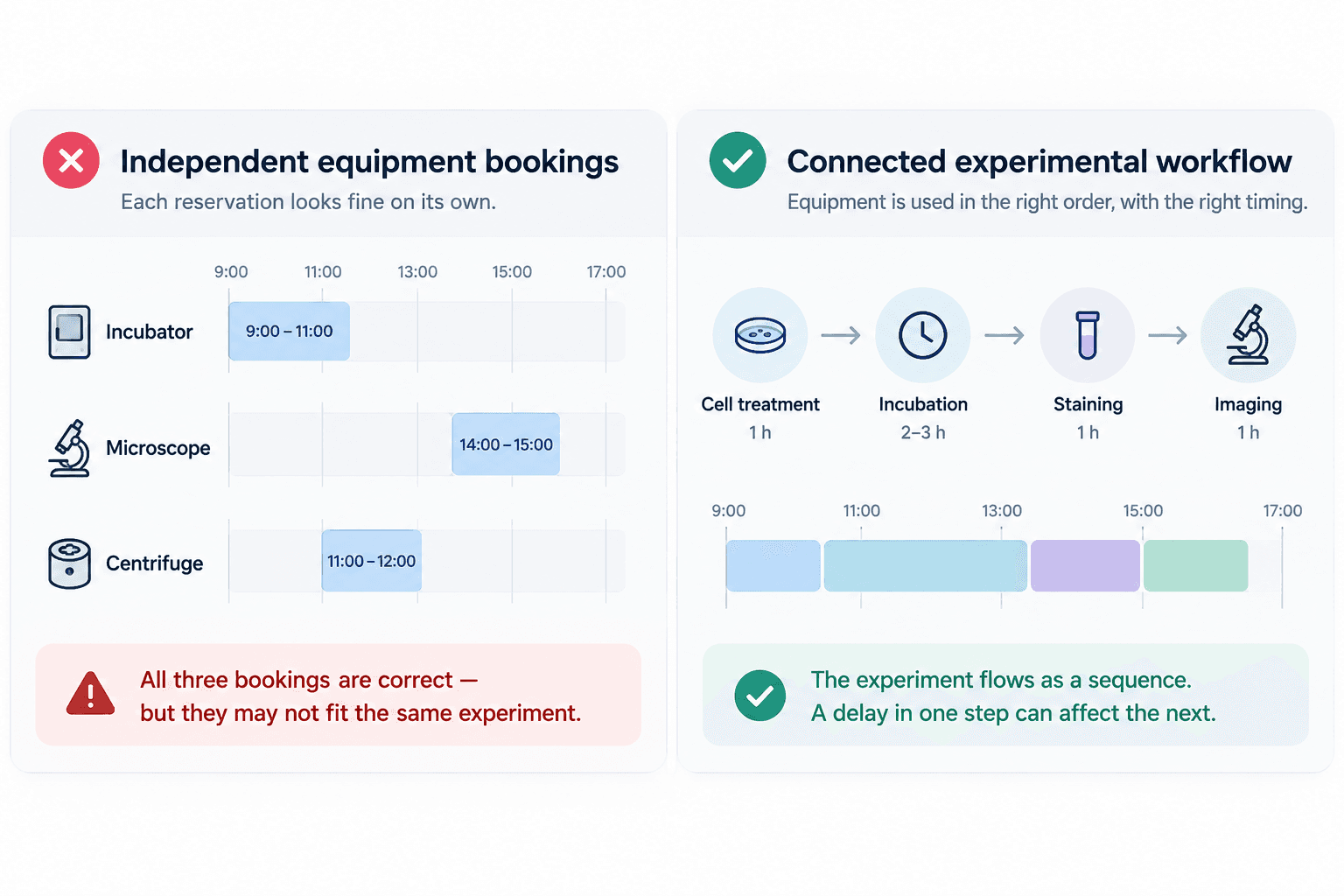
A booking can be perfectly valid on a calendar and still fail to fit the experiment it was made for. In a cell-based imaging assay, treatment, incubation, staining and microscopy form a sequence. If preparation runs late, the imaging slot may no longer work — even though the reservation itself has not changed.
A Calendar Shows Slots. A Protocol Shows Dependencies.
Equipment calendars answer who has reserved an instrument and when. Protocols answer a different question: what must happen before the next step can begin?
Multi-step experiments combine active work, waiting periods and access to shared resources. Some steps can move; others depend on specific time windows, sample conditions or trained operators. When bookings are made independently, those dependencies may remain in personal notes rather than in the shared schedule.
Waiting Time Is Not Empty Time
An incubation period may not require an instrument booking, but it still determines when the next step can begin. Reserving the microscope too early can leave a slot unused; booking too late may affect sample quality or require the workflow to change.
The timing limits of an experiment should always come from its validated method and the researcher's judgment — not from assumptions made by a scheduling tool.
When One Step Moves, Others May Follow
A delay in preparation may mean adjusting imaging, checking another instrument's availability or coordinating with a colleague who operates it. Each reservation can be accurate on its own while the overall plan becomes difficult to follow.
That is why multi-step scheduling is about more than finding free slots. It is about seeing how related steps fit together and recognizing which later bookings might need attention.
Four Questions Worth Asking Before You Book
- Sequence: Which steps must finish before the next can start?
- Resources: Which instruments, setups or people are needed?
- Timing: Which windows are fixed, and which are flexible?
- Changes: If one step runs late, what else needs to be revisited?
Try mapping one recurring experiment from preparation to measurement. Mark its waiting periods, equipment requirements and time-sensitive transitions. Compare that workflow with how your lab currently makes reservations.
Where FluentProtocols Fits In
This is the thinking behind FluentProtocols at LabFluent. It is designed to help researchers organize repeatable, multi-step workflows and coordinate the equipment bookings that go with them — instead of treating each reservation as an isolated event.
It does not replace scientific judgment or eliminate experimental uncertainty. The goal is simpler coordination around the science, so researchers can focus on the work itself.
A better planning question is not just “Is the microscope free?” but “Will it be available when the experiment actually needs it?”
Or contact us to talk about how your laboratory plans and coordinates multi-step experiments.