
Two researchers need the same microscope on Thursday afternoon. Both have experiments planned around it. On Wednesday, one learns that sample preparation is running late and moves their booking.
The calendar changes. But does everyone affected know? A colleague may have been waiting for that slot. Another researcher may need time to prepare the instrument. A facility manager may still be answering messages about what is available.
In a shared lab, access is not just about finding an empty space on a calendar. It is about keeping people, instruments and changing plans aligned.
A Free Slot Is Not the Whole Story
A booking shows when someone intends to use equipment. It does not necessarily tell the next person whether the instrument is ready, whether maintenance is scheduled, or whether special training or setup is required.
These details matter most where instruments are shared across teams with different schedules and priorities. A slot can look free while practical access remains uncertain. Conversely, an early cancellation may create an opportunity that another researcher never hears about.
Better coordination starts by making the right information available at the point where someone makes a booking decision — not by asking everyone to check another spreadsheet, inbox or chat.
Four Questions Every Shared Lab Should Be Able to Answer
When something changes, a simple coordination check can reveal where friction begins:
- Who is affected? Which researchers have bookings or experiments dependent on the instrument?
- What has changed? Is it a cancellation, a delayed experiment, an instrument issue or a change in access rules?
- What happens next? Can another researcher use the released time, or does the instrument need preparation before the next booking?
- Where is the current information? Can the team find the same answer without a round of messages?
Consider a last-minute cancellation. If only the original user knows about it, the released time may go unused while someone else waits for access. A small, reliable way to communicate that change can be more valuable than adding another reporting dashboard.
None of these questions requires a complicated process. The goal is a shared understanding of the situation, with fewer interruptions and less avoidable back-and-forth.
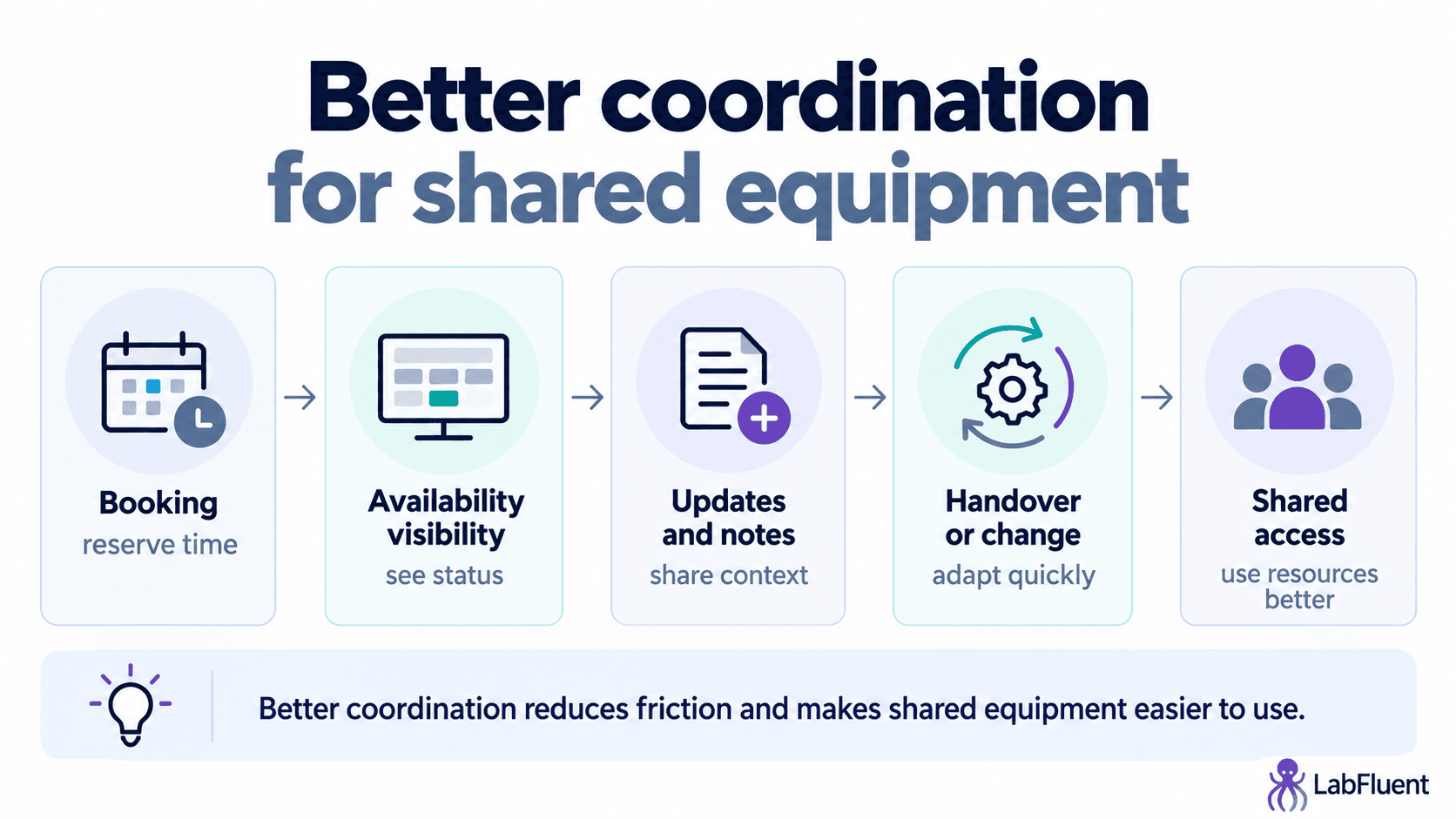
Access Should Feel Fair and Predictable
Better coordination is also about expectations. Shared equipment may be heavily used by one group and only occasionally needed by another. Peak hours can be competitive, and urgent experiments do not always fit neatly into fixed schedules.
Clear local rules can help: reasonable booking windows, cancellation practices, handover expectations and a known contact for exceptions. The right rules depend on the lab. What matters is that researchers can understand them before a conflict appears.
For specialized instruments, local rules may also need to account for supervision, handover time and safety requirements. Fair access does not always mean treating every booking as interchangeable.
A consistent process reduces the need for one person to negotiate every change manually.
Better Resource Use Begins With Better Visibility
When labs understand where access is difficult, they can make more informed decisions about existing equipment. Repeated peak-time conflicts may indicate a scheduling issue, a training constraint or genuine demand for additional capacity. Those possibilities call for different responses.
Importantly, bookings are not the same as measured physical utilization. A reservation may be canceled, end early or remain unused. Scheduling information can highlight patterns worth investigating, but it should not be presented as proof of actual instrument use — or of reduced energy use or emissions.
This distinction matters when lab managers discuss budgets or sustainability: better coordination supports decisions, but it does not by itself establish a measurable impact.
Still, clearer access and better planning may help teams make more thoughtful use of resources they already share.
Start With One Instrument, Not a System Overhaul
Pick an instrument that generates frequent questions. For two weeks, notice where coordination happens outside the booking process. Are people asking about status, switching slots, or looking for information in different places?
Then choose one improvement: a clearer availability view, a consistent way to communicate changes, or simpler rules for releasing unused time. Review whether it removed work for researchers before adding anything else.
At LabFluent, we believe shared-equipment tools should make this coordination lighter, not create another administrative layer. The best workflow is one researchers can actually use.
Or contact us to talk about how your laboratory currently coordinates access to shared equipment.