When a shared instrument stops working, the repair is often the most visible cost.
But in a research lab, downtime rarely affects only the equipment.
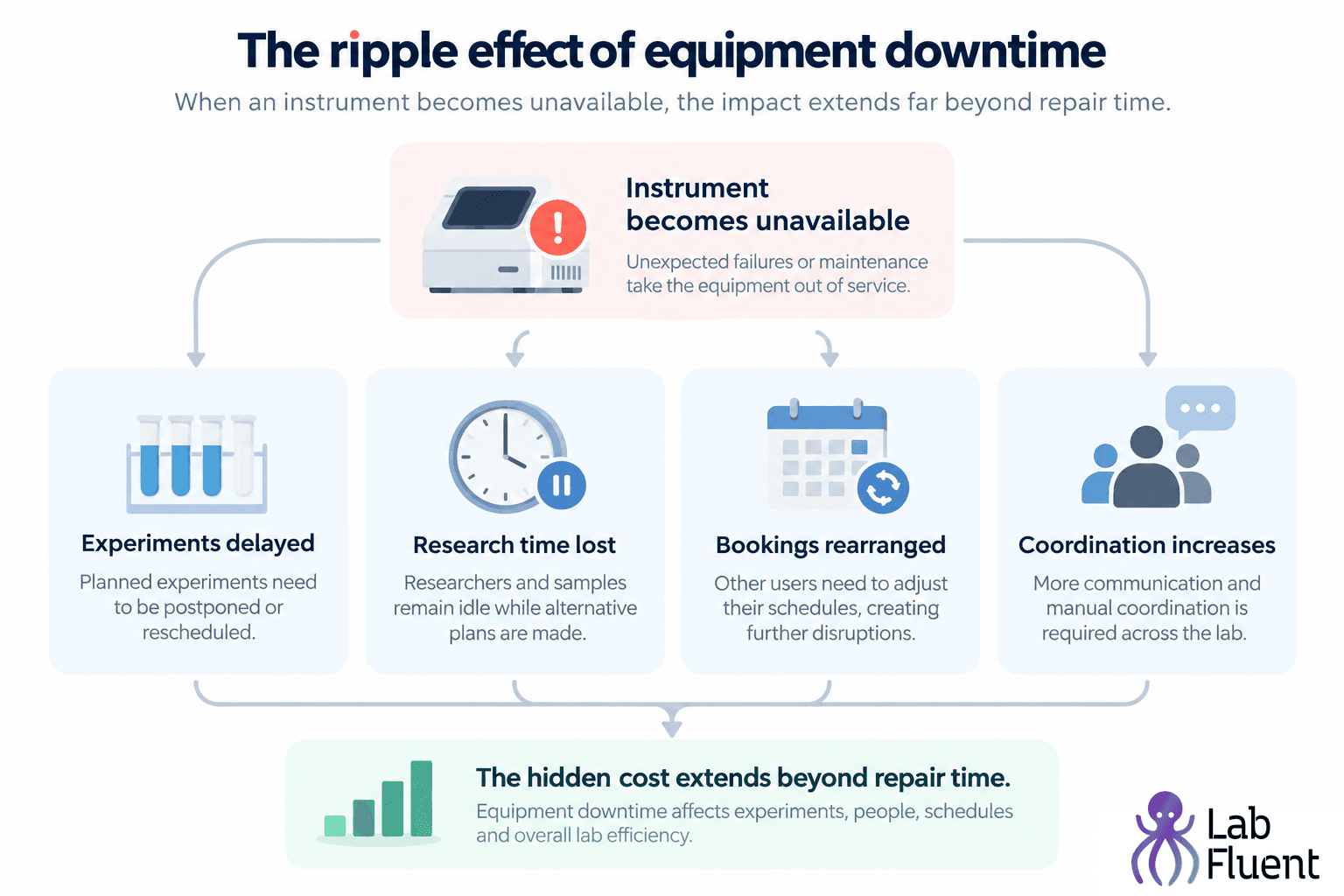
A failed centrifuge, microscope or plate reader can also interrupt experiments, delay samples, force researchers to reschedule work and create a chain of coordination that spreads well beyond the instrument itself.
That is why the real cost of downtime is often larger than the maintenance invoice.
Downtime Disrupts More Than a Booking
A booking calendar might show that an instrument is unavailable for two hours. Operationally, the impact can be much wider.
A researcher may already have prepared samples. Another experiment may depend on the result. A collaborator may be waiting for data. A replacement instrument may exist, but it may already be booked by another team.
In shared facilities, the disruption can multiply quickly because several users may have planned work around the same piece of equipment. One unexpected issue can affect not only the current booking, but also later bookings, handovers and downstream steps that depend on a specific time window.
The interruption can therefore create several kinds of hidden work:
- rescheduling experiments,
- finding alternative equipment,
- informing other users,
- repeating preparation steps,
- updating project timelines,
- and reorganizing work around the new constraint.
None of these actions appears on the repair bill, but they still consume research time.
Planned and Unplanned Downtime Are Different
Not all downtime is a problem.
Preventive maintenance, calibration and planned servicing are necessary parts of running reliable scientific equipment. When they are visible early enough, researchers can often plan around them.
Unplanned downtime is different. The difficulty is not simply that the equipment is unavailable. It is that the change arrives after researchers have already built their plans around expected access.
The later the problem becomes visible, the more coordination it can create.
This makes status communication important. If an issue is known but only mentioned in a chat, email or conversation, other researchers may continue planning around an instrument that is no longer usable.
A technically correct booking schedule can therefore still give an incomplete operational picture.
Downtime Can Distort Utilization Decisions
A full calendar can make an instrument look heavily utilized. But booking pressure does not always mean the lab needs more capacity.
If researchers repeatedly lose time because an instrument is unavailable, unreliable or waiting for maintenance, the real bottleneck may be downtime rather than demand.
The opposite can happen too. An instrument with fewer bookings may still be important if it supports a critical workflow or has limited alternatives.
That is why utilization should be interpreted with context. Booking history can help show demand, but equipment status, cancellations, recurring issues and downtime events can help explain why the pattern looks the way it does.
This context can also improve conversations about maintenance and investment. Before assuming that another instrument is needed, it can be useful to understand whether the existing bottleneck comes from genuine capacity pressure, repeated downtime or a coordination problem around access.
Visibility Makes the Impact Easier to Understand
Labs do not need an elaborate measurement program to start learning from downtime. Even basic questions can be useful:
- How often does an instrument become unexpectedly unavailable?
- Which equipment creates the most rescheduling?
- Are the same issues recurring?
- How quickly do users learn that equipment is unavailable?
- Does downtime regularly push work onto another instrument?
The goal is not to turn every equipment issue into another administrative task. It is to make important operational information easier to see when it already affects the work. For many labs, that starts with moving beyond spreadsheets and scattered messages.
The Hidden Cost Is Coordination
The cost of equipment downtime is not only the time an instrument is offline. It is also the researcher time spent adapting around it.
For some labs, that impact may be small. For others, a single unavailable shared instrument can affect several people, experiments and timelines at once.
The useful question is therefore not only:
“How long was the equipment down?”
It is also:
“How much work did the downtime create around it?”
At LabFluent, we think better visibility around shared equipment can help labs coordinate these disruptions with less friction — without making researchers responsible for another layer of administration.
Make your lab fluent.
Or contact us to talk about how your laboratory currently manages shared equipment, availability and downtime.